If you’ve ever worked in construction, mining, or agriculture, you know heavy machinery isn’t just big—it’s heavy. A single excavator can weigh north of 80 tons, a farm combine sometimes hits 60 tons, and hauling any of that on a standard flatbed trailer is a recipe for disaster. For years, I’ve spoken to operators who try to cut corners, towing oversized loads with regular rigs, only to end up stuck on a ramp, violating weight limits, or worse, causing road damage. That’s why, as a special trailer supplier, one of the most common questions I get is: “Can a special trailer really handle heavy machinery transport?” The short answer is yes—but it’s not just any special trailer. It’s a custom-built solution engineered to solve the unique problems that come with moving 50 to 200 tons of equipment, and it’s the difference between a smooth, compliant load and a costly, dangerous headache. Special Trailer

Let’s start with why standard trailers fail. A typical semi-trailer is built for loads of 10 to 25 tons, with a weight distribution system designed for evenly spread cargo. Heavy machinery, though, isn’t evenly distributed. Take a bulldozer: its engine and tracks sit at the front, so 60% of its total weight rests on the first third of the undercarriage. A standard trailer’s axles are spaced evenly, so they can’t support that concentrated weight without exceeding axle load limits—most countries cap single axles at 12 to 14 tons and groups of axles at 20 to 24 tons per axle. Exceeding those limits leads to worn road surfaces, which can get you cited by state or federal transportation authorities, and worse, risk a blowout or axle failure mid-haul. Standard trailers also lack the ground clearance and low-profile design needed for oversize machinery. Excavator arms, for example, stick out high above the undercarriage, and a standard trailer’s 14-inch ground clearance might scrape on a railroad crossing or a steep off-ramp, damaging both the trailer and the machinery.
Special trailers fix these issues through three core customizations: axle configuration, load distribution, and terrain adaptability. First, axle layouts aren’t one-size-fits-all. I recently worked with a mining company moving a 120-ton haul truck. Instead of a standard 5-axle setup, we built a 12-axle modular trailer with a “steerable” axle system that lets each pair of axles pivot independently. That 12-axle setup spreads the 120-ton load across 24 contact points on the road, keeping each axle under the 14-ton limit required for cross-country transport. No citations, no road damage, and the load stayed compliant even when we crossed state lines—each of which had slightly different axle rules. Modular trailers also let you adjust the number of axles based on the load: if a farmer needs to move a 40-ton combine, we can remove 4 of the 12 axles to cut down on transport costs, without sacrificing safety.
Next, load distribution is where special trailers shine. Heavy machinery isn’t just heavy—it’s unbalanced. Take a front loader, where the bucket adds significant weight to the front. A standard trailer would leave that weight hanging over the trailer’s kingpin, putting too much stress on the tractor unit. Special trailers use adjustable goosenecks and deck sections to shift the load’s center of gravity. For the front loader, we can move the forward deck section back 3 feet, shifting 10 tons of the bucket’s weight onto the trailer’s mid-axles instead of the tractor. For a large excavator with a long arm that sticks out behind the tracks, we add a rear extension deck to balance the load, so the rear of the trailer doesn’t lift up during transit. This center of gravity adjustment is non-negotiable: if a load’s center is too high or too far forward/backward, it can tip over at highway speeds, even on a gentle curve.
Then there’s terrain adaptability, a factor most suppliers overlook. Construction sites and mining operations aren’t paved parking lots—they’re rutted dirt roads, steep inclines, and uneven ground that would stop a standard trailer in its tracks. Special trailers come with features like hydraulic suspension systems that adjust to terrain in real time. Each axle can rise or fall independently, so a wheel hitting a 6-inch pothole doesn’t lift the rest of the trailer, keeping all axles on the ground and the load stable. For off-road jobs, we build trailers with thicker steel frames, reinforced tires rated for heavy loads, and winch systems that can pull machinery onto the deck without external equipment. I had a customer last year in rural North Dakota who needed to move a 70-ton corn harvester across a 5-mile dirt track to their field. A standard trailer would have gotten stuck in the mud, but our special 8-axle off-road trailer, with reinforced track pads and low-pressure tires that spread the load over a larger area, made the trip without a single delay.
But here’s the thing: not all “special trailers” are equal. Some suppliers cut corners, using generic axles or one-size-fits-all designs, and call them custom. That’s why, as someone who’s been building these for 12 years, I always tell customers to look for three key features when shopping for a heavy machinery transport trailer: load testing documentation, compliance with local transportation codes, and modular adjustability. Load testing isn’t just a formality—when we build a trailer for 150 tons, we test it at 120% of that weight in our workshop, bending, twisting, and stressing the frame to make sure it won’t fail on the road. Compliance means making sure the trailer meets the exact rules for every state or country you’ll be crossing. For example, some European countries limit total trailer length to 16.5 meters, while U.S. states allow up to 20 meters for oversize loads. Modularity is important too: if you’re moving different machines (a bulldozer one month, a combine the next), a modular trailer lets you adjust axles and deck size, instead of buying a new trailer every time.
I also want to address a common misconception: some operators think that hiring a generic heavy hauler is cheaper than buying or renting a special trailer. But when you factor in citations, road damage fees, and downtime if your load gets stuck, that “cheaper” option often ends up costing three times as much. Last year, a small construction firm in Ohio tried to move a 60-ton excavator using a standard flatbed and an extra set of axles they borrowed. They got cited $12,000 for excess axle weight, had to pay $8,000 to repair a county road they damaged, and lost 3 days of work waiting for a permit to re-route. Had they used our custom 6-axle lowboy trailer, which is designed for 60-ton loads, they would have had no citations, no road damage, and made the delivery on time.
Another point to consider is safety for the machinery itself. Heavy equipment is expensive—a new excavator can cost $500,000, a haul truck $1.2 million. A standard trailer’s rigid frame can flex during transit, causing the undercarriage to shift, scratch paint, or even misalign hydraulic systems. Special trailers have adjustable tie-down points and non-slip deck surfaces that secure machinery firmly, while shock-absorbing suspension reduces vibration, protecting delicate parts like engines and electronics. I recently delivered a trailer to a mining company that moved electric haul trucks—our custom design included rubberized deck padding that prevented scratching, and GPS tracking to monitor the load’s speed and suspension, so they could adjust their route if the terrain was too rough.
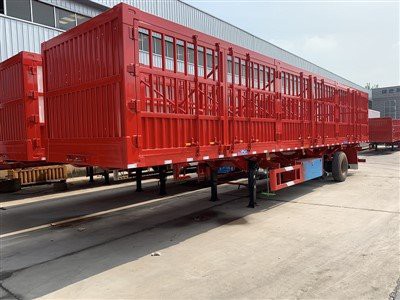
So, can a special trailer be used for transporting heavy machinery? Absolutely. But it’s not just a yes or no answer—it’s about choosing the right special trailer for your specific load, route, and needs. Whether you’re moving a 40-ton farm combine across country, a 100-ton excavator to a construction site, or a 150-ton haul truck to a mine, a custom-built special trailer is engineered to handle the weight, balance the load, and navigate the terrain, while keeping your equipment safe, compliant, and your project on schedule. If you’re tired of dealing with standard trailers that can’t keep up with your heavy machinery transport needs, I’d encourage you to reach out to discuss your requirements. Together, we can design a trailer that fits your exact load, route, and budget, so you never have to worry about stuck loads, citations, or damaged equipment again.
Pallet Transport Semitrailer REFERENCES
- Federal Motor Carrier Safety Administration. "Heavy Vehicle Weight and Dimension Regulations for Commercial Motor Vehicles," Department of Transportation, 2022.
- National Institute for Occupational Safety and Health. "Transportation of Heavy Construction Equipment: Safety Guidelines," Centers for Disease Control and Prevention, 2021.
- International Road Transport Union. "Cross-Border Transport of Oversize Heavy Loads," IRU Report, 2023.
- Society of Automotive Engineers. "Design and Testing of Heavy-Duty Modular Trailers," SAE International Journal of Commercial Vehicles, 2020.
Shandong Tengyun Special Vehicle Manufacturing Co., Ltd.
Shandong Tengyun Special Vehicle Manufacturing Co., Ltd. is well-known as one of the leading special trailer manufacturers and suppliers in China. Please feel free to buy high quality special trailer made in China here from our factory. For price consultation, contact us.
Address: Middle Section of Dongfeng Road, Liangshan Street Office, Liangshan County, Jining City, Shandong Province
E-mail: 15634517777@163.com
WebSite: https://www.tengyuntruck.com/
